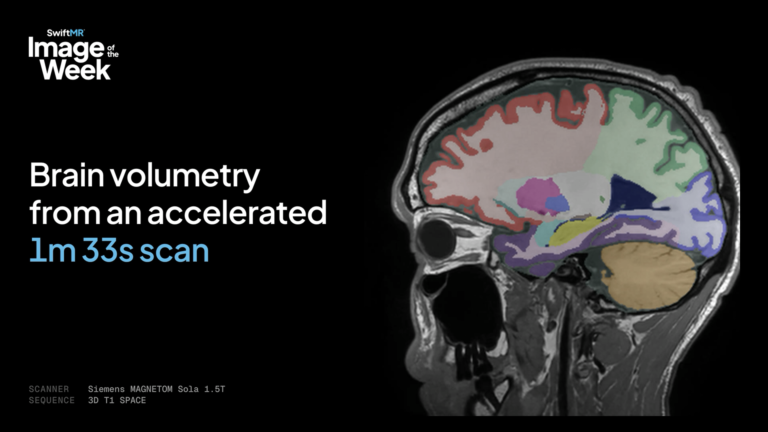
1:33 3D T1 Brain Volumetry with SwiftMR and SwiftSight
Most volumetry protocols lean on a 4 to 5 minute MPRAGE. This week's 3D T1 SPACE was acquired in 1:33, reconstructed with SwiftMR, then segmented in S...
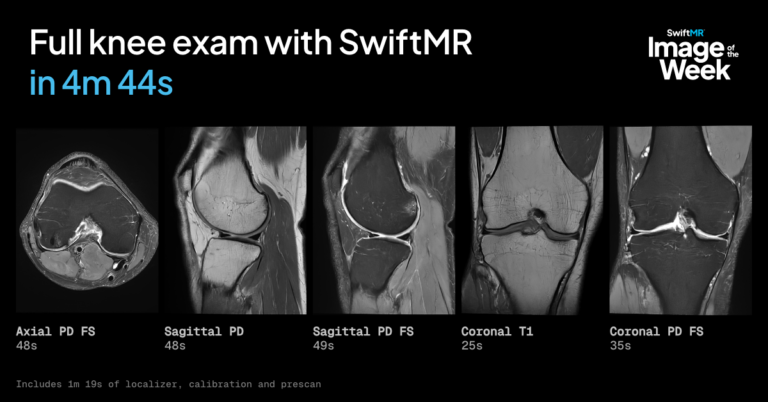
Five-Sequence Knee MRI in 4:44 with SwiftMR
Five sequences. One complete knee MRI protocol. Just 4 minutes, 44 seconds — including localizer, calibration, and prescan.
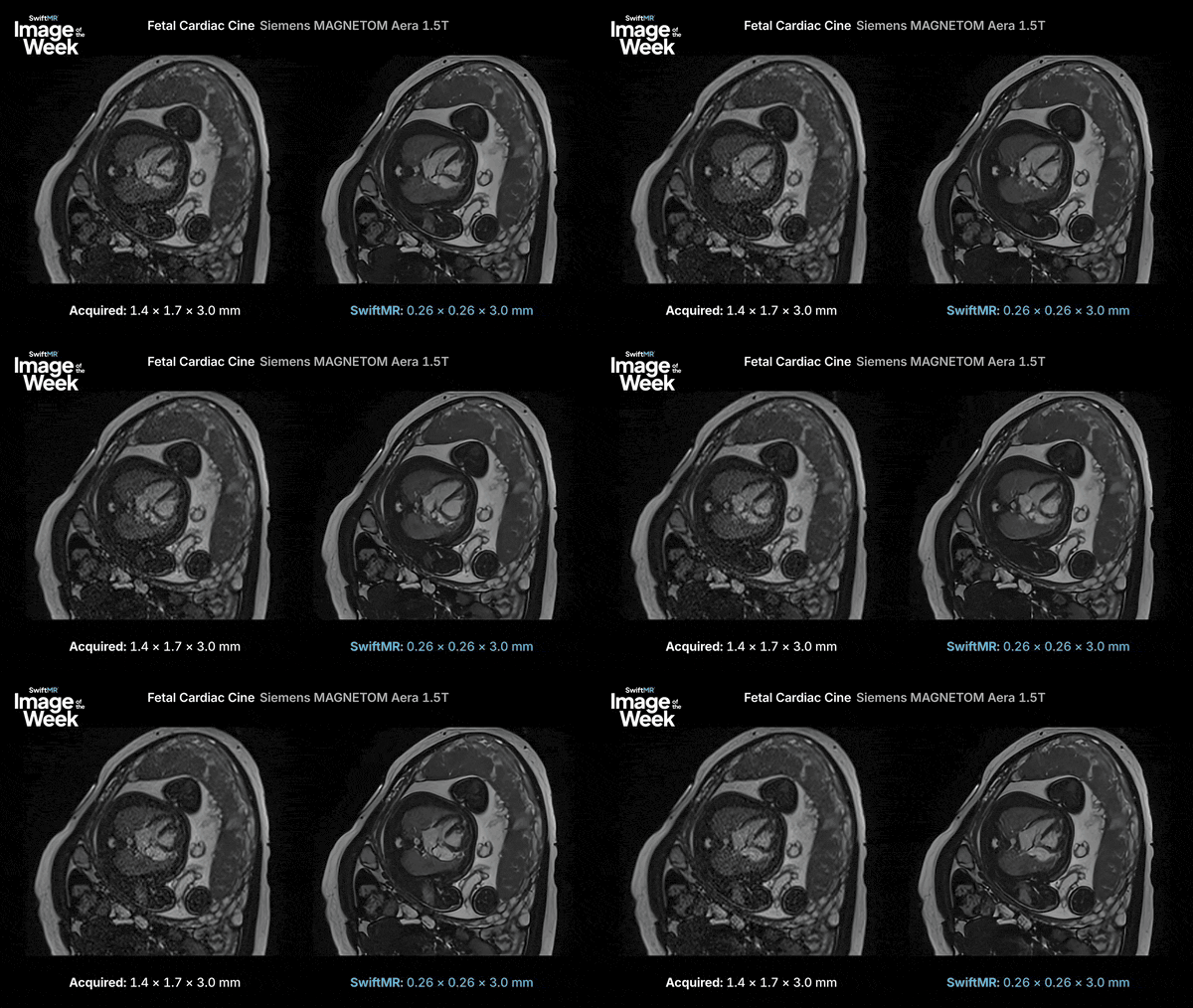
Fetal Cardiac Cine MRI: Deep Learning Reconstruction at 1.5T
Same fetal cardiac acquisition. Look at what changes after deep learning reconstruction.
Scanner Spotlight: Siemens MAGNETOM Altea 1.5T with SwiftMR
More Performance from a System Built for Productivity
The Siemens Healthineers MAGNETOM Altea is a 70 cm bore 1.5T system built for high-throughput clinical...
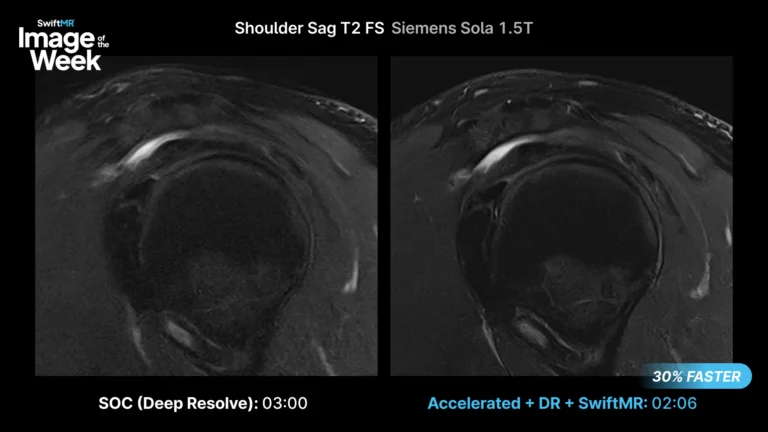
Sagittal T2 FS in 2:06 on a Siemens Sola 1.5T
The scanner's own deep learning reconstruction had already accelerated this sequence. Adding SwiftMR after it took another 54 seconds off.
Scanner Spotlight: GE Discovery MR750
Balancing Image Quality and Acquisition Time on the GE Discovery MR750
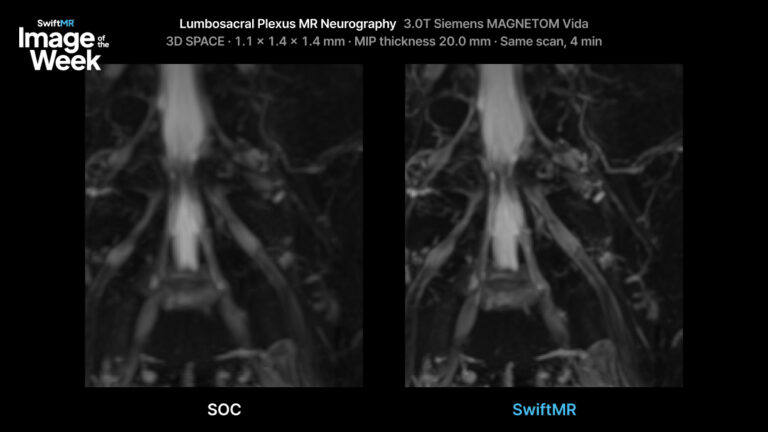
Lumbosacral Plexus MR Neurography: Image Quality with SwiftMR
When a patient has persistent leg pain and a lumbar spine MRI does not fully explain the symptoms, attention may turn beyond the spine itself to the lumbosacral...

MRI Super Resolution vs. Interpolation: What's the Difference?
Interpolation changes pixel spacing. Super Resolution reconstructs smaller voxels.

Scanner Spotlight: GE Optima MR450w 1.5T, 36% to 44% Faster with SwiftMR
SwiftMR helps imaging organizations get more from the GE Optima MR450w 1.5T—reducing scan times, creating more predictable appointment slots, and increasing...

Sagittal T2 Lumbar Spine in 2:14 on a Fujifilm APERTO 0.4T
For imaging organizations operating established low-field or open MRI systems, reconstruction technology can provide another way to improve the performance...

SwiftMR FGATIR in 8:07 on a Siemens Avanto 1.5T
Twelve minutes of holding still, for a patient who can’t
Ask someone with essential tremor to stay perfectly still for twelve minutes and twenty-four...
Scanner Spotlight: SwiftMR for Siemens MAGNETOM Espree 1.5T
SwiftMR extends the clinical and operational value of a legacy Siemens Espree 1.5T—reducing scan times, improving image quality, and creating more capacity...
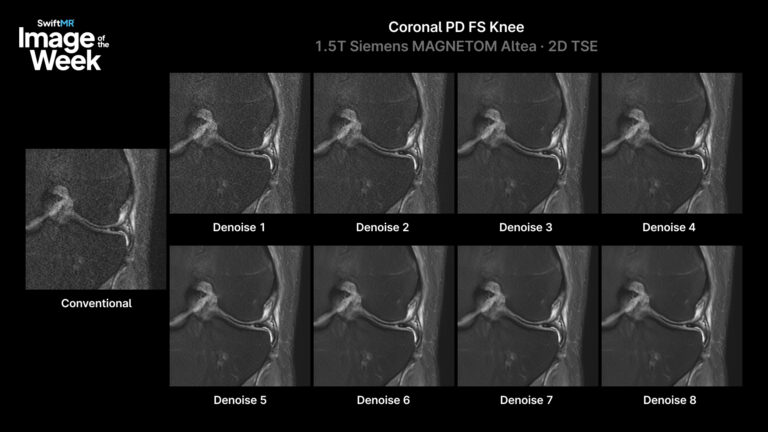
SwiftMR: 8 Tunable Denoising Levels for Knee MRI on Siemens Altea 1.5T
Eight Denoising Levels: What Changes—and What Doesn’t?
There is no single definition of a good MRI image.
Resolution, contrast, noise, and texture...
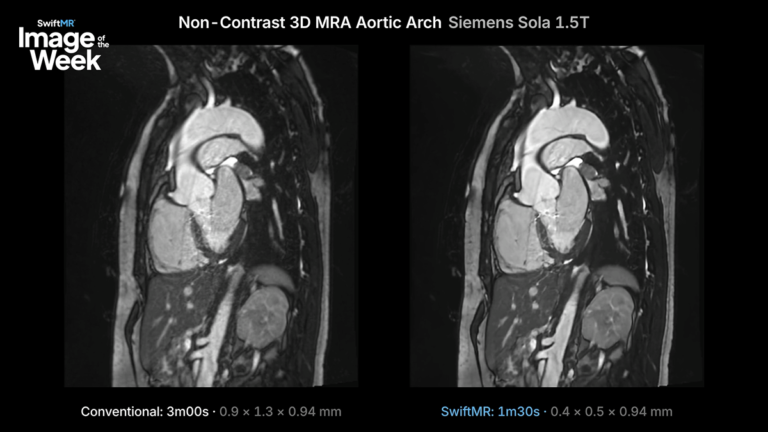
SwiftMR 50% Faster Non-Contrast 3D Aortic Arch MRA
3:00 → 1:30: Accelerating Non-Contrast 3D Aortic Arch MRA with Deep Learning Reconstruction
Non-contrast 3D MRA of the aortic arch can add valuable anatomical...
Scanner Spotlight: SwiftMR for Siemens MAGNETOM Skyra 3T
Hospitals and diagnostic imaging centers evaluating SwiftMR for Skyra 3T scanners are usually after the same three things: more clinical capacity, more...