How much time does your routine knee MRI really take?
For MRI technologists and imaging operations teams, reducing scan time isn’t just about accelerating individual sequences. It’s about improving efficiency across the entire exam while maintaining the image quality needed for clinical interpretation.
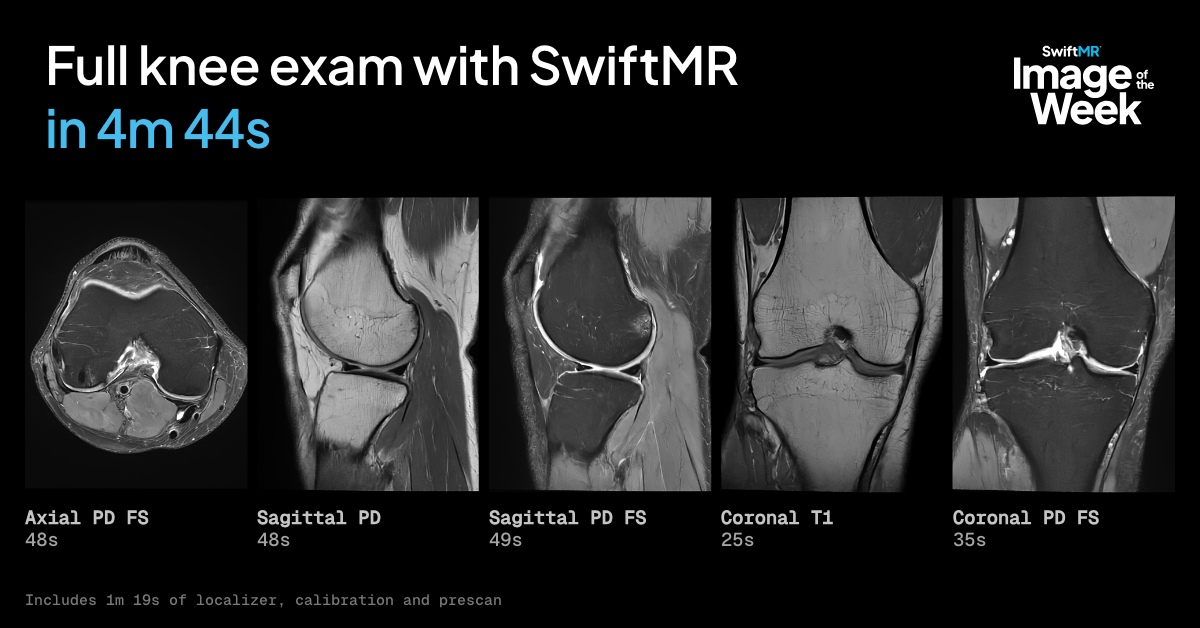
This week’s Image of the Week demonstrates what’s possible with SwiftMR®, AIRS Medical’s AI-powered MRI acceleration and image enhancement technology.
Acquired on a United Imaging uMR Omega 3T, this five-sequence knee MRI was completed in just 4 minutes and 44 seconds, with no individual sequence lasting more than 49 seconds.
Breaking Down the Five-Sequence Knee MRI Protocol
The protocol includes five routinely used knee MRI sequences, all acquired in under one minute each.
| MRI sequence | Acquisition time |
|---|---|
| Axial PD Fat-Saturated | 48 seconds |
| Sagittal PD | 48 seconds |
| Sagittal PD Fat-Saturated | 49 seconds |
| Coronal T1 | 25 seconds |
| Coronal PD Fat-Saturated | 35 seconds |
| Total sequence acquisition | 3:25 |
| Localizer, calibration and prescan | 1:19 |
| Total exam scan time | 4:44 |
Images were acquired at 0.45 × 0.65 × 3.0 mm, with reconstruction to 0.16 × 0.16 mm in-plane using SwiftMR.
The important distinction is that 4:44 represents the reported complete scanner exam time, not simply the sum of accelerated imaging sequences.
Why the Longest Sequence Matters for MRI Technologists
For technologists performing knee MRI, one number stands out: 49 seconds.
That’s the longest continuous sequence in this exam.
Patients presenting with acute knee injuries, swelling, or pain may find it difficult to remain motionless during prolonged acquisitions. Patient movement can introduce motion artifacts, potentially requiring repeat sequences and adding time to an already busy MRI schedule.
Shorter individual acquisitions reduce the time patients must remain still during each sequence, which may help limit opportunities for motion.
In this example, every sequence is completed in less than a minute.
For patients, that means shorter periods of remaining still. For technologists, it creates an opportunity for a more efficient examination workflow.
Why Total Knee MRI Time Matters More Than a Single Accelerated Sequence
MRI acceleration is often demonstrated using individual sequences. While those improvements are important, they don’t necessarily tell the full operational story.
A faster sagittal or axial acquisition is only one part of the examination.
What matters to imaging operations is how those time savings translate across the entire protocol.
That includes sequence acquisition as well as the localizers, calibration, and prescan activities necessary to complete the examination.
The distinction is particularly relevant when evaluating different MRI acceleration technologies, including OEM deep learning (DL) reconstruction and vendor-neutral solutions such as SwiftMR.
SwiftMR can also work alongside supported OEM DL solutions, offering opportunities for additional acceleration and broader sequence coverage.
Rather than evaluating individual sequence improvements alone, imaging organizations should consider total protocol times, clinical image requirements, workflow compatibility, and the potential impact on overall scanner utilization.
The United Imaging example presented here is a SwiftMR protocol demonstration, not a head-to-head OEM DL comparison.
From Faster Knee MRI to Greater Operational Efficiency
Reducing scan acquisition time can create opportunities beyond a shorter examination.
For imaging centers and radiology departments, faster MRI protocols may help:
- Improve patient experience: Reduce the time patients spend remaining still during imaging.
- Support technologist workflow: Shorten individual acquisitions and potentially reduce motion-related repeat sequences.
- Increase scheduling flexibility: Create opportunities to optimize examination slots and scanner utilization.
- Improve existing scanner productivity: Explore additional capacity without immediately investing in new MRI hardware.
However, achieving measurable throughput improvements requires evaluating the entire patient workflow, including positioning, preparation, scanner availability, and room turnaround.
A five-minute acquisition doesn’t automatically mean a five-minute appointment.
That’s why complete protocol measurements are essential when assessing the operational value of MRI acceleration.
See the Difference with SwiftMR
This five-sequence knee MRI illustrates how SwiftMR can support rapid image acquisition across a complete musculoskeletal protocol on an existing 3T MRI system.
For MRI technologists, radiologists, and imaging operations leaders, the question isn’t simply how fast one sequence can run.
It’s how efficiently the entire examination can be completed while meeting clinical imaging requirements.
What’s your routine knee MRI protocol running today?
Learn More
Explore more SwiftMR clinical images in the AIRS Medical clinical image gallery.
For additional clinical examples or to discuss your MRI protocols, contact Anthony Rodenberg, BA, R.T.(R)(MR)(ARRT), Director, Clinical Programs.