Extend the Performance of Your GE Optima MR450w
The GE Optima MR450w 1.5T with GEM Suite was built to combine wide-bore patient comfort with strong image quality and efficient MRI workflow. Its 70 cm bore, feet-first imaging capabilities, and GEM Suite help accommodate a broad patient population while supporting routine neuro, spine, musculoskeletal, body, vascular, and other clinical exams.
It was also designed around workflow. Optical RF supports signal clarity, Acoustic Reduction Technology helps reduce scanner noise, a large 50 × 50 × 50 cm field of view supports broader anatomical coverage, and IntelliTouch positioning and in-room controls help simplify patient setup and exam prescription.
The MR450w, however, can still face a familiar operational challenge: scan time. Exams that run 20, 30, or more than 40 minutes can limit scheduling flexibility, reduce available capacity, and make it harder to absorb urgent cases or delays throughout the day. Longer acquisitions also require patients to remain still for extended periods, increasing the opportunity for motion-related image degradation.
For hospitals and imaging centers already operating an MR450w, the opportunity is not necessarily to replace a capable scanner. It is to improve its performance—shortening acquisitions, creating more predictable appointment times, and getting greater clinical and operational value from the system already in place.
The Optima MR450w Challenges for MRI Technologists
The MR450w was designed to streamline patient setup and workflow, but once an examination begins, acquisition time can still consume a significant portion of the appointment.
The MR450w is a 1.5T system, so protocols requiring higher resolution or stronger signal-to-noise may need acquisition parameters that preserve sufficient signal, limiting how aggressively scan time can be reduced. Many examinations also consist of multiple sequences, with Brain + Options, Lumbar + Options, Knee + Options, and other multiparametric studies adding acquisition time as each sequence is completed.
More demanding applications—including diffusion, high-resolution imaging, contrast studies, cardiac imaging, and fMRI—can require multiple acquisitions. Technologies such as GEM Suite and IntelliTouch help streamline patient setup, positioning, coil handling, and workflow around the examination, but they do not eliminate the time required to acquire each sequence within the prescribed protocol.
The Business, Operational, and Clinical Impact of the GE Optima MR450w
Imaging executives want to know how much more capacity an existing GE Optima MR450w can produce before a new scanner enters the capital plan.
For MRI managers and operations leaders, the challenge is protecting throughput while maintaining predictable schedules and patient care. Reducing acquisition time can create more flexibility for urgent cases, delays, and additional patients within the existing operating day.
For radiologists, faster examinations only create value when the resulting images maintain the anatomical detail and image quality required for confident interpretation. On a 1.5T platform, that means shortening acquisitions without introducing unacceptable noise, loss of detail, or motion-related degradation.
The following results show how imaging organizations used SwiftMR to reduce scan times across GE Optima MR450w systems and translate those gains into shorter appointment slots, greater scheduling flexibility, and more capacity from the scanners already in service.
SwiftMR Delivered 36%–44% Average Scan-Time Reduction Across GE Optima MR450w Sites
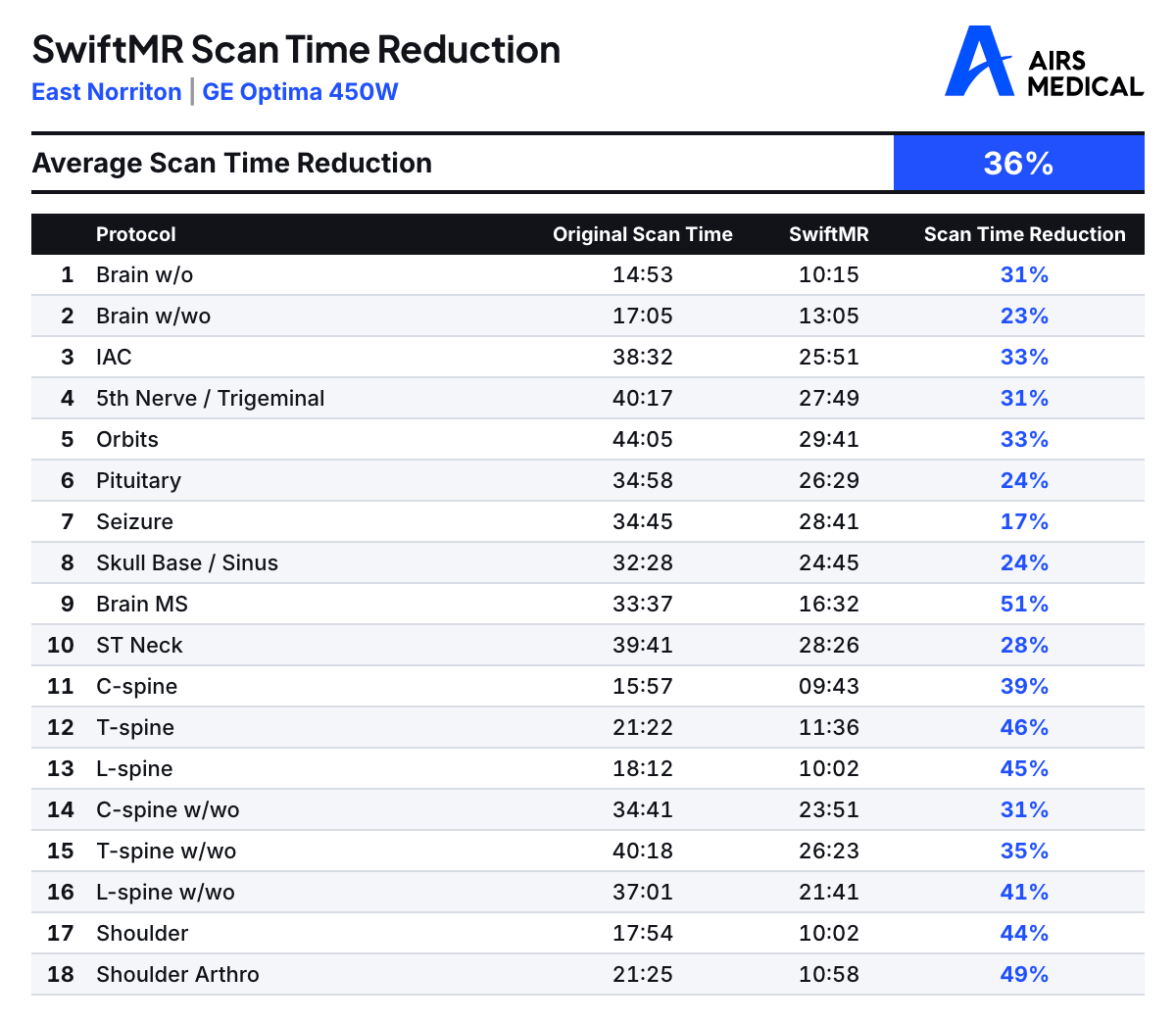
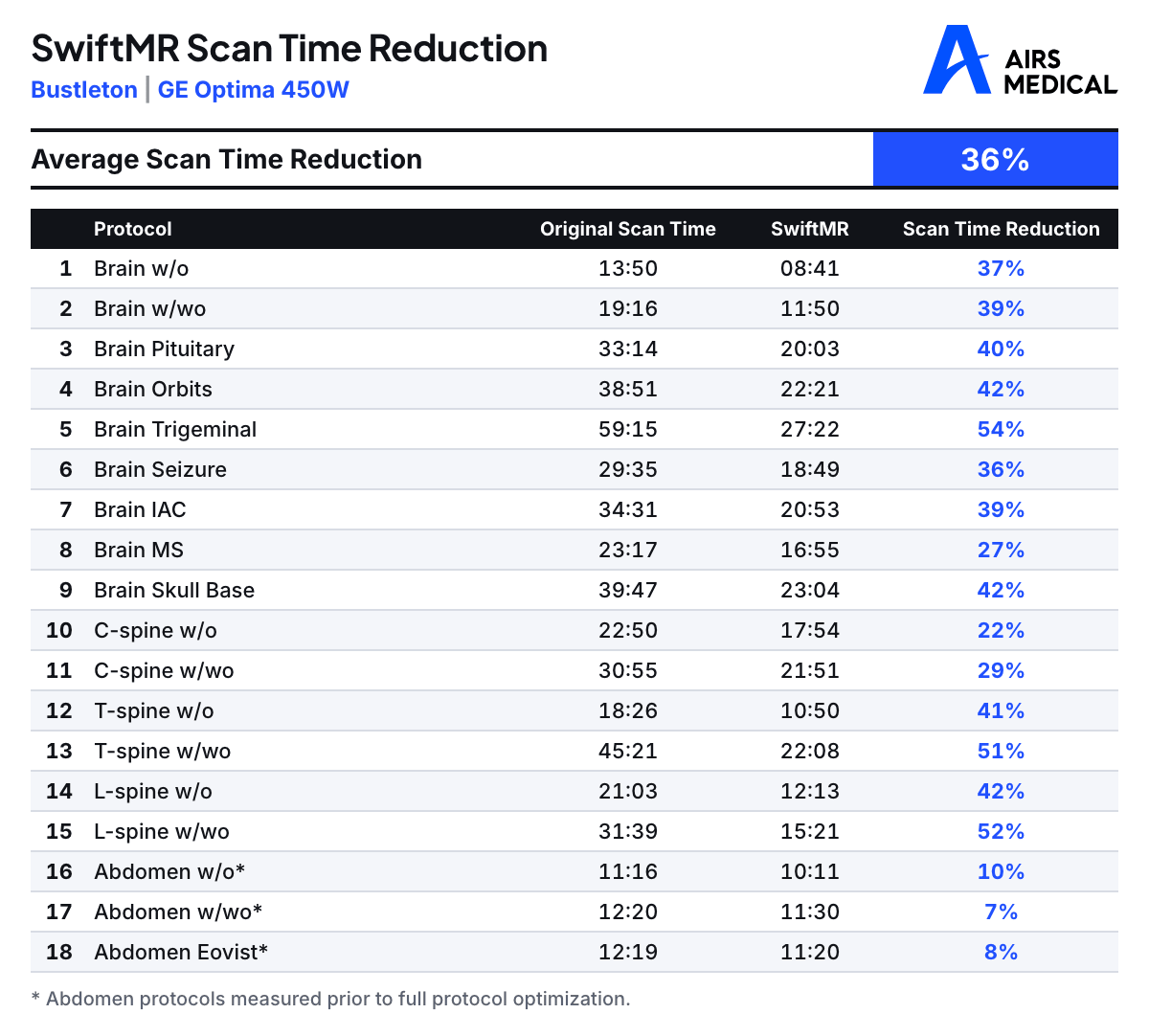
Across multiple GE Optima MR450w 1.5T installations, SwiftMR delivered site-level average scan-time reductions of 36% to 44%, demonstrating acceleration across different sites and clinical workloads.
Average scan-time reductions included:
- Bustleton, Jefferson Health: 36%
- East Norriton, Jefferson Health: 36%
- Trinity Health of New England: 44%
That consistency matters. Rather than delivering a large reduction on one favorable sequence, SwiftMR demonstrated meaningful acceleration across separate MR450w installations and a range of clinical examinations.
Trinity Health: 44% Average Scan-Time Reduction
At Trinity Health of New England, SwiftMR reduced scan times by an average of 44% across seven GE Optima MR450w 1.5T protocols, with individual reductions ranging from 34% to 57%.
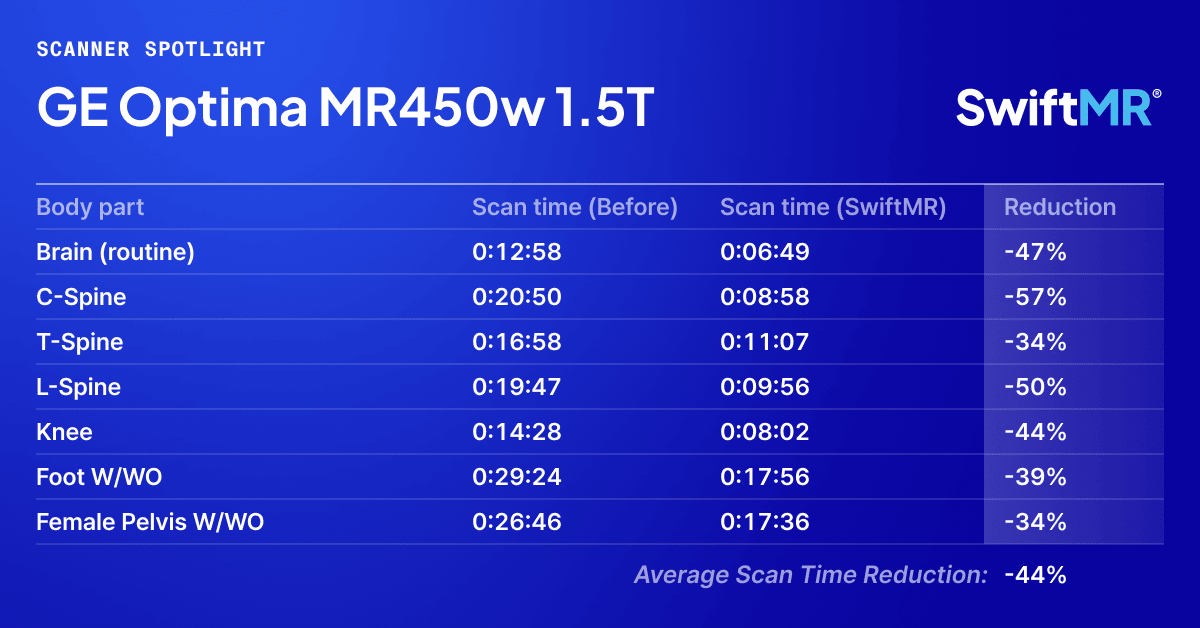
The results demonstrate meaningful acceleration across separate MR450w installations and a broad range of clinical examinations—not just one scanner or selected protocol.
The impact extended beyond acquisition time. Trinity Health reduced contrast appointment slots from 45 to 30 minutes and non-contrast slots from 30 to 20 minutes, converting recovered acquisition time into bookable schedule time.
GE Optima MR450w Results: Up to 52% Faster
Additional GE Optima MR450w 1.5T protocol data show acceleration across neuro, spine, musculoskeletal, body, and prostate imaging.
| Protocol | Before | With SwiftMR | Time saved | Reduction |
|---|---|---|---|---|
| Brain + Options | 42:55 | 33:10 | 9:45 | 22.7% |
| Pituitary | 14:58 | 8:54 | 6:04 | 40.6% |
| Cervical | 12:48 | 7:44 | 5:04 | 39.6% |
| Lumbar + Options | 25:19 | 16:32 | 8:47 | 34.7% |
| Knee + Options | 20:06 | 12:51 | 7:15 | 36.1% |
| Ankle | 18:08 | 12:33 | 5:35 | 30.8% |
| Hip + Options | 25:29 | 15:46 | 9:43 | 38.1% |
| Prostate | 20:53 | 15:33 | 5:20 | 25.5% |
| Shoulder | 16:13 | 7:43 | 8:30 | 52.4% |
The Percentage Only Tells Part of the Story
The shoulder protocol achieved the largest percentage reduction at 52%, dropping from 16:13 to 7:43.
But for MRI managers, the actual minutes recovered can be just as important:
- 9:45 saved on Brain + Options
- 9:43 saved on Hip + Options
- 8:47 saved on Lumbar + Options
- 8:30 saved on Shoulder
- 7:15 saved on Knee + Options
Recovering seven to nearly ten minutes from commonly performed examinations can add meaningful flexibility across a full MRI schedule.
The results also span neuro, spine, musculoskeletal, and prostate imaging, providing opportunities to recover time across the clinical workload rather than on one isolated examination.
SwiftMR Turns Faster MR450w Scans Into More Capacity
For imaging executives, SwiftMR adds MRI capacity without a capital purchase.
For operations teams, that shows up as the 15 minutes Trinity cut from its contrast appointment slots and the 10 minutes it cut from non-contrast slots.
For radiologists, additional capacity only creates value if accelerated examinations continue to provide the image quality and anatomical detail needed for confident interpretation.
Together, the results show how SwiftMR’s AI reconstruction can turn scan-time savings on the GE Optima MR450w into shorter appointment slots, greater scheduling flexibility, and more imaging capacity from the scanner already in place.
Get More from Your GE Optima MR450w
See what SwiftMR does to your scan times, on your GE Optima MR450w, with your protocols. AIRS Medical offers a free trial with matched DICOM series, allowing your team to evaluate the results in its own clinical environment.
Frequently Asked Questions
How much can SwiftMR reduce scan times on a GE Optima MR450w?
Results vary by site, scanner configuration, protocol, and clinical requirements. Across the GE Optima MR450w installations highlighted here, average scan-time reductions ranged from 36% to 44%, with individual protocols demonstrating reductions as high as 57%.
Does faster imaging on the GE Optima MR450w compromise image quality?
SwiftMR is designed to accelerate acquisition while maintaining the image quality required for clinical interpretation. During protocol optimization, image quality factors including signal-to-noise ratio, spatial resolution, image uniformity, artifacts, geometric accuracy, and slice thickness are evaluated before accelerated protocols are approved for clinical use.
Can shorter acquisitions help reduce motion-related image degradation?
Shorter acquisitions reduce the window during which patient motion can occur. A patient who has to hold still for 7 minutes rather than 16 has fewer opportunities to move, though SwiftMR does not correct motion that does occur.
Does SwiftMR change image contrast or anatomical appearance?
SwiftMR protocol optimization is designed to preserve TR, TE, and image contrast. Acceleration comes from acquisition parameters such as NEX, parallel imaging, bandwidth, and ETL, with SwiftMR reconstruction recovering signal-to-noise. Every accelerated protocol is reviewed for resolution, uniformity, artifacts, and geometric accuracy before clinical release.