The GE Discovery MR750 was built as a high-performance 3T platform for demanding neuro, musculoskeletal, spine, body, vascular, and other advanced MRI applications. 3T field strength provides the signal needed for high-resolution imaging and complex protocols where anatomical detail, contrast, and acquisition performance matter.
That performance, however, comes with trade-offs. High-resolution imaging and larger fields of view extend scan time; fat-suppressed and RF-intensive sequences push SAR toward its 3T ceiling. Both raise the odds of motion creeping into a multiparametric exam, where those individual sequence times add up fast.
For radiologists, faster imaging only creates value when accelerated acquisitions continue to provide the anatomical detail, contrast, and image characteristics required for interpretation.
For hospitals and imaging centers already operating a Discovery MR750, the opportunity is not necessarily to replace a capable 3T scanner. Rather than replacing an existing system, why not maximize its full potential—accelerating scan speeds while enhancing the operational efficiency and clinical utility of the installed scanner.
The Discovery MR750 Challenges for MRI Technologists
For technologists, optimizing the Discovery MR750 means managing the trade-offs that come with high-performance 3T imaging.
Protocols requiring high spatial resolution, fat suppression, or larger fields of view may require additional attention to shimming and sequence parameters. SAR can limit how aggressively sequences (e.g. fat-sat FSE, high-ETL T2) can be optimized, while longer or more complex examinations increase the opportunity for patient motion and repeat imaging.
The challenge for technologists is balancing the MR750’s available signal and resolution with acquisition time—building protocols that deliver the imaging radiologists need without unnecessarily extending the examination.
The Business, Operational, and Clinical Impact of the Discovery MR750
Imaging executives want to know how much more capacity an existing Discovery MR750 can produce before longer operating hours, additional staffing, or another scanner enters the capital plan.
For MRI managers and operations leaders, reducing acquisition time can create more flexibility within a busy 3T schedule—helping teams recover from delays, accommodate urgent studies, and potentially increase the productive capacity of an existing scanner.
Clinically, the requirement remains unchanged: any accelerated protocol must continue to support the intended diagnostic task.
Case Study: SwiftMR Delivers a 49% Reduction in Scan Time on the Discovery MR750
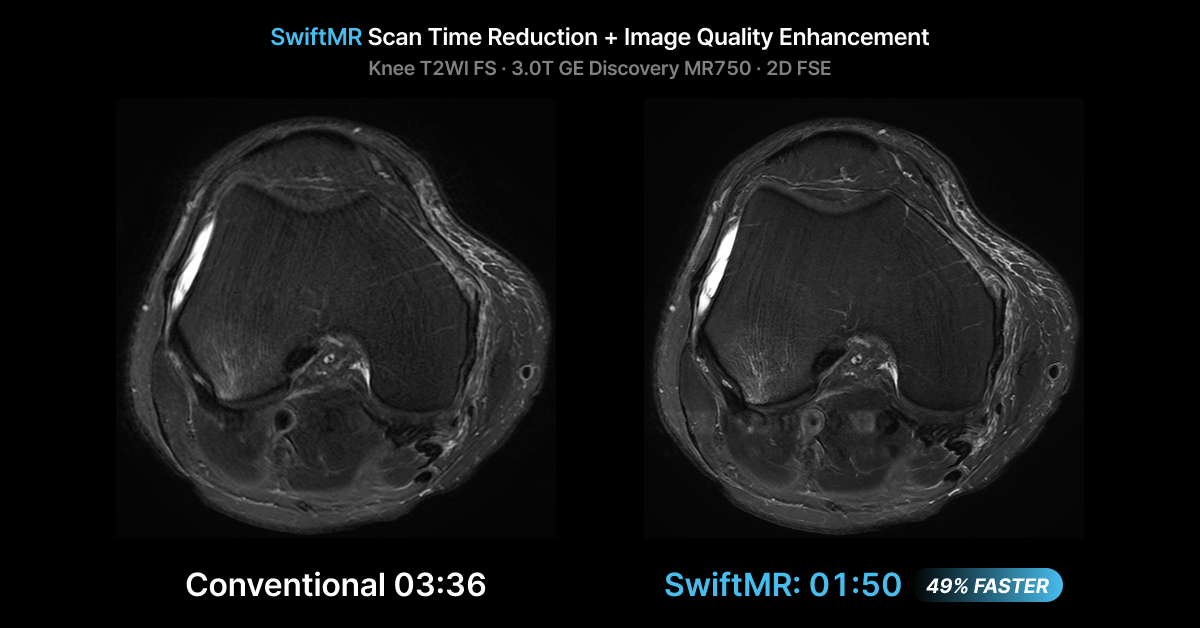
On a GE Discovery MR750 3T, SwiftMR reduced a knee T2-weighted fat-suppressed acquisition from 3:36 to 1:50 — a 49% reduction in scan time — while maintaining the same listed voxel size of 0.4 × 0.4 × 3.0 mm.
| Parameter | Conventional | SwiftMR |
|---|---|---|
| Sequence | Knee T2WI FS | Knee T2WI FS |
| Acquisition | 2D FSE | 2D FSE |
| Voxel size | 0.4 × 0.4 × 3.0 mm | 0.4 × 0.4 × 3.0 mm |
| Scan time | 3:36 | 1:50 |
| Time reduction | — | 49% |
What Does a 49% Reduction Actually Mean?
Reducing the knee T2-weighted fat-suppressed acquisition from 3:36 to 1:50 saves 1 minute 46 seconds on a single sequence.
For the patient, that means less time spent holding still during the acquisition—important in musculoskeletal imaging, where pain or discomfort can make motion more likely.
For the technologist, it creates more flexibility within the exam if additional positioning, coaching, or repeat imaging is required.
For the MRI schedule, those saved minutes can begin to add up when similar reductions are achieved across multiple clinically accepted sequences and repeated across a full day of exams.
The result is not automatically another appointment slot, but it can create more usable scanner time, greater schedule flexibility, and less pressure when delays accumulate.
For radiologists, the value of that time savings still depends on one thing: whether the accelerated acquisition continues to provide the anatomical detail, contrast, and image characteristics required for the intended diagnostic task.
Why This Knee Sequence Is a Useful Test Case
A T2-weighted fat-suppressed knee acquisition is a meaningful example because it has to preserve fluid-sensitive contrast and anatomical detail while managing noise, fat suppression, and acquisition time.
The interesting point is not simply the 49% number. It is that the time reduction was achieved on a sequence where contrast, fat suppression, tissue detail, and image texture all matter to interpretation.
See What SwiftMR Can Do on Your Discovery MR750
Try SwiftMR on the GE Discovery MR750 you use every day. With a free trial and matched DICOM comparisons, your radiologists and technologists can assess the impact on acquisition time and image quality using familiar protocols and real-world workflow.
Frequently Asked Questions
Does a 49% reduction in scan time mean diagnostic image quality is preserved?
Not automatically. In the Discovery MR750 knee example, SwiftMR cut acquisition time from 3:36 to 1:50 at a matched 0.4 × 0.4 × 3.0 mm voxel size — but matched voxel size isn’t the same as matched image quality. Diagnostic acceptability still comes down to contrast, tissue detail, fat suppression, noise, artifacts, and image texture for the intended clinical task, confirmed by a side-by-side read rather than the DICOM header alone.
How does SwiftMR affect image texture and noise?
SwiftMR uses deep learning reconstruction to reduce noise and recover SNR lost to acceleration. In some configurations it can also increase effective resolution beyond the acquired matrix. Because reconstruction changes the appearance and texture of an image either way, radiologists should evaluate accelerated and SwiftMR-processed series using the image characteristics they rely on in routine interpretation.
Can SwiftMR be optimized differently for different MR750 sequences?
Yes. MRI protocols have different requirements depending on anatomy, weighting, resolution, and diagnostic purpose. SwiftMR can be evaluated at the sequence and protocol level rather than assuming one reconstruction approach is appropriate for every acquisition.
Is the benefit limited to musculoskeletal MRI?
No. The Discovery MR750 supports a broad range of neuro, spine, body, vascular, and musculoskeletal imaging. The knee case is one scanner-specific example of the potential for acquisition-time reduction; the achievable reduction will vary by sequence and protocol.