When deep learning (DL)–based image reconstruction first entered clinical MRI, it arrived with a healthy dose of skepticism. Radiologists and technologists had every reason to ask hard questions: Is the model altering anatomy? Is it removing subtle findings? Can we trust it?
Fast-forward to today, and the landscape looks very different. DL reconstruction has matured. Models have improved. Evidence has accumulated. Confidence has grown. And DL is now reshaping MRI workflows by breaking long-standing trade-offs that once felt immutable.
For decades, MRI lived under the tyranny of the “trade-off triangle”: speed, SNR, and resolution—pick two. DL reconstruction is changing that. Suddenly, acceleration no longer demanded noisy images. High resolution no longer required long scans. For many in the field, this shift felt almost unbelievable. I can accelerate more, go faster, and still get low-noise, high-resolution images?
Naturally, new capabilities bring new questions. How do these models work? How do they differ? Is one approach superior? And now, with SwiftMR recently FDA-cleared for use in combination with all OEM DL solutions, an even bigger question emerges:
Can multiple DL processes be applied to the same data without compromising image quality or diagnostic confidence?
Let’s unpack that.
Understanding the Foundations: What DL Reconstruction Touches
MRI reconstruction is a mathematically dense process. Raw k-space data must pass through a series of transformations—each influenced by factors like:
- k-space coverage (kmax)
- Δk
- Partial Fourier
- Elliptical sampling
- Noise variance
- Uniform vs. random undersampling
- Acceleration factors
Each of these parameters affects image quality in a different way. And each OEM has historically chosen to focus on a specific subset of these dimensions when designing their DL models that operate at the raw data/k-space level.
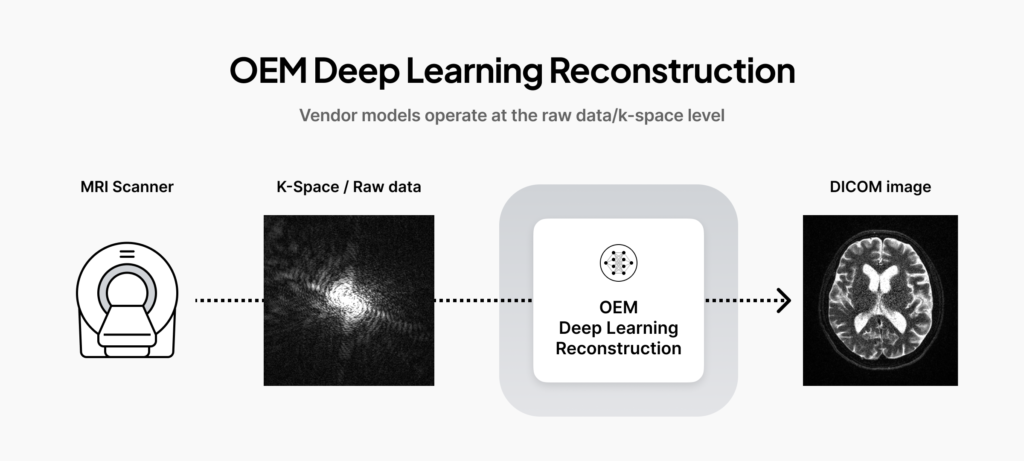
In practice, this means:
OEM DL solutions tend to excel in one or two areas—but no single OEM model addresses the full spectrum of image-quality determinants.
That’s not a flaw; it’s a design choice. Each vendor builds around its own strengths, hardware, and reconstruction philosophy.
But it also creates limitations.
Where SwiftMR Fits In
SwiftMR takes a fundamentally different approach.
Instead of targeting a narrow slice of the reconstruction pipeline, SwiftMR was built as an all-in-one, DICOM-based enhancement framework designed to operate across a broad range of clinical and technical scenarios.
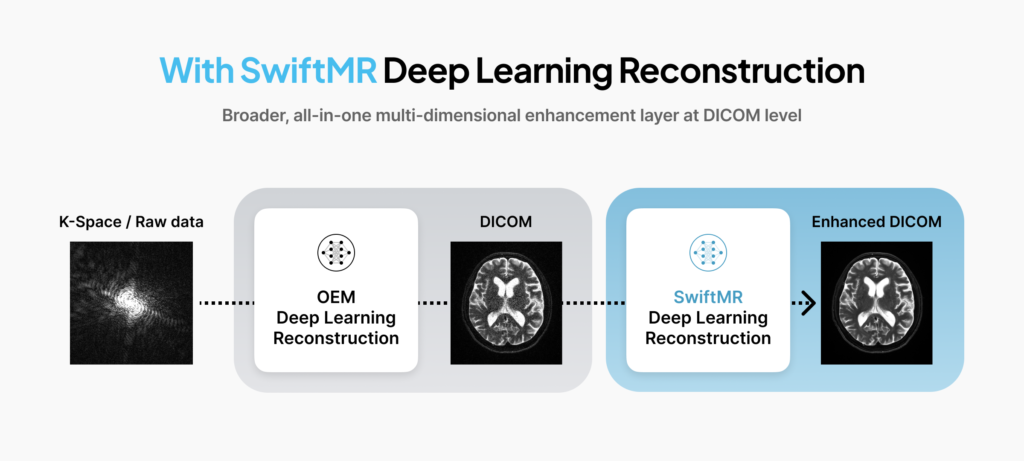
SwiftMR evaluates multiple scan parameters, acceleration techniques and reconstruction characteristics simultaneously, enabling it to:
- Improve image quality across multiple dimensions of acceleration
- Reduce noise and enhance edge detail
- Maintain consistency across scanners, sites, protocols, coils, software levels, and field strengths
In other words, SwiftMR is not tied to a specific k-space sampling strategy, software level or vendor-specific reconstruction method.
So… Can You Combine OEM DL With SwiftMR?
Yes—and that’s exactly what SwiftMR’s recent FDA clearance enables.
Here’s the key idea:
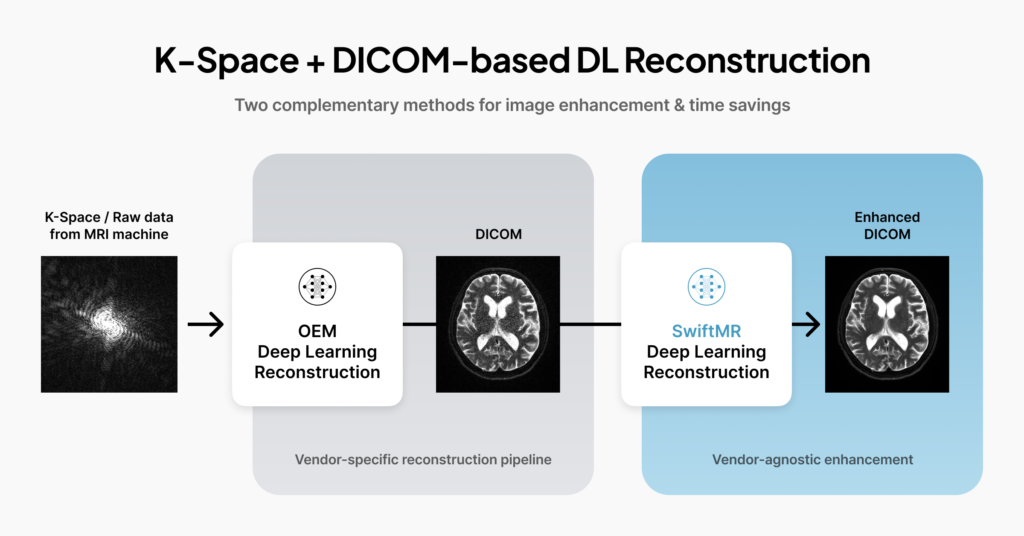
OEM DL solutions improve image quality along the dimensions they were designed for. SwiftMR enhances the dimensions they don’t address.
When combined, the strengths of each approach stack rather than interfere.
Think of it like this:
- OEM DL handles vendor-specific reconstruction pipelines and optimizations
- SwiftMR provides a broader, all-in-one multi-dimensional enhancement layer at the DICOM level
- Together, they deliver higher acceleration potential and improved image quality across more scenarios than the OEMs could alone
This combination doesn’t overwrite or distort the OEM’s reconstruction. Instead, it builds on it—extending benefits into areas the OEM model wasn’t designed to optimize.
Putting It All Together
Each OEM has developed powerful DL tools tailored to their hardware and reconstruction pipelines. These solutions are strong at what they were built to do—but by design, they focus on a limited set of image-quality and acceleration dimensions.
SwiftMR fills the gaps.
By pairing OEM DL with SwiftMR’s all-in-one framework, radiology practices can achieve:
- Higher throughput by utilizing multiple acceleration techniques
- Greater protocol standardization across their fleet regardless of system age, software and hardware configurations
- More consistent image quality across diverse technical scenarios
- Enhanced diagnostic confidence
- Broader applicability across scanners, sequences, protocols and anatomies
The result is a more flexible, more powerful, and more comprehensive MRI DL-enhanced solution—empowering practices to improve image quality and operational efficiency without compromising image quality and diagnostic confidence.
Anthony Rodenberg BA RT(R)(MR)
Director Clinical Programs
AIRS Medical