
The normative database problem we wanted to solve
Brain volumetry is only as clinically meaningful as the reference population behind it. For example, telling a clinician that a 72-year-old patient’s hippocampal volume is 0.42% of intracranial volume is nearly useless without knowing how that data compares to healthy people of the same age and sex.
That’s the problem normative databases solve.
But not all normative databases are built the same way. And those differences matter.
A normative database should do more than place a patient on a curve. It should help clinicians interpret a measurement in the right biological and clinical context, so they can make more informed assessments for the person in front of them.
That was the standard we held ourselves to.
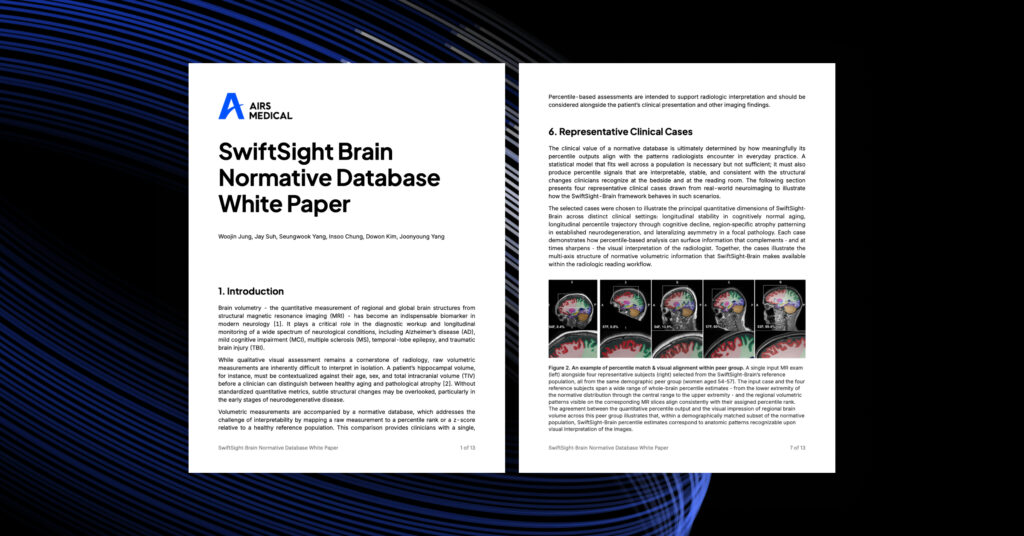
That is why we expanded the SwiftSight-Brain Normative Database and detailed the methodology in a new white paper. The updated database includes 32,615 subjects, ages 18 to 97, acquired across Siemens Healthineers, GE, and Philips scanners at both 1.5T and 3T, and drawn from international populations and consent-governed sources.
Here’s what’s different and why.
Database scale matters
Normative databases are not interchangeable. Their clinical value depends on the size, diversity, and structure of the reference population behind the percentile output.
The expanded SwiftSight-Brain Normative Database includes 32,615 subjects, ages 18 to 97, making it one of the largest normative reference populations in quantitative brain MRI. The database includes data acquired across Siemens Healthineers, GE Healthcare, and Philips scanners, both 1.5T and 3T field strengths, and international populations.
That scale matters.
A larger and more representative reference population supports more stable age- and sex-adjusted percentile estimation, especially across older age ranges where healthy reference data can be harder to obtain and inter-individual variability increases.
It also better reflects the realities of clinical imaging environments, where patients are scanned across different vendors, field strengths, and acquisition protocols.
Compared with many established MRI normative databases, which are built from smaller reference cohorts, SwiftSight-Brain provides a broader foundation for interpreting brain volumetry in clinical practice.
The problem: highly flexible curve-fitting
Many normative frameworks use highly flexible statistical models — generalized additive models, splines — to fit percentile curves to observed brain volume data. These methods are powerful, but flexibility comes with a cost. In age ranges where healthy data are sparse (particularly older adults), flexible models can produce unstable, biologically implausible trajectory estimates. The percentile curves may “wiggle” in ways that reflect sampling noise rather than real neurological patterns.
We took a different approach.
Our solution: a model that reflects how the brain actually ages
SwiftSight-Brain uses what we call the shifted-softplus model, a parametric model designed around established neurological knowledge rather than statistical convenience.
The result is a smoother, more biologically plausible reference curve, especially in older age ranges where sparse data can make purely flexible models unstable.
Decades of longitudinal neuroimaging research have demonstrated that brain atrophy doesn’t progress at a constant rate across adulthood. Volume loss is relatively gradual in earlier decades and then accelerates, notably around age 60. We built our database to capture this exact trajectory.
How? Each parameter is directly interpretable:
- Curvature: the degree of late-life acceleration
- Linear slope: the baseline rate of early-adult volume change
- Inflection age: when accelerated decline emerges (estimated between 58–62 years across structures)
- Vertical offset: baseline volume at the inflection point
Our shifted-softplus model isn’t a statistical trick — it’s a model that encodes what neuroscience already knows, then lets the data confirm it.
Eliminating age-dependent variance
As people age, brain volumes become more variable — cumulative differences in genetics, lifestyle, vascular risk factors, and health history compound over decades. A normative model that assumes constant variance across the lifespan will be miscalibrated: too narrow for older adults, too wide for younger ones.
SwiftSight-Brain models this directly by jointly fitting percentile curves across multiple variance levels, allowing the normative distribution to widen naturally with age. In older populations where inter-individual variance is largest, our percentile estimates remain appropriately calibrated to the age group being assessed.
Asymmetry: the signal absolute volumes can miss
Normative databases are often used to compare absolute brain volumes against a reference population. But absolute volume is not always enough.
In a representative case from our validation set — a 30-year-old female undergoing pre-surgical evaluation for refractory temporal lobe epilepsy — absolute hippocampal volumes appeared within the lower range of the normative distribution and would not have triggered conventional abnormality flags. But the hippocampal asymmetry index fell well below the 1st percentile.
That is the signal an absolute volume comparison can miss. SwiftSight-Brain reports asymmetry as a standard normative output, expressed as a percentile relative to the reference population.
Multi-axis percentile output for clinical clarity
A single global brain score can obscure the regional specificity of neurological disease.
For example, Alzheimer’s disease progression is often associated with early medial temporal and hippocampal atrophy, progressive temporal cortical thinning, and ventricular enlargement as neurodegeneration advances. These are distinct regional signals that may evolve along different trajectories.
SwiftSight-Brain solves this by providing region-specific, age- and sex-adjusted percentiles across the full structural atlas. This helps clinicians identify diverging regional patterns and quantitatively track longitudinal change to support earlier recognition of subtle atrophic changes.
A new transparent model for clinical interpretation
Clinical tools should be interpretable.
Radiologists and neurologists should not just be handed a percentile and told to trust it. They should be able to understand what shaped that percentile including age, sex, expected brain-aging trajectory, variance, and the model parameters behind the curve.
That is why SwiftSight-Brain uses a shifted-softplus model with trajectories that are transparent by design. Each parameter corresponds to something clinicians can recognize, including the baseline rate of change, the point where decline accelerates, and the degree of late-life acceleration.
Together, these design choices reflect the new standard for brain normative databases, one that must include a broad clinical reference population, a model shaped by established neurological knowledge, calibration for age-dependent variance, and outputs transparent enough for clinicians to interpret.
Because in brain MRI, the value of volumetry does not come from the number alone. It comes from the quality of the comparison behind it — and whether that comparison helps clinicians make sense of the patient in front of them.
Explore the expanded SwiftSight-Brain Normative Database and see how its 32,615-subject reference population supports more meaningful quantitative brain MRI interpretation.