OEM deep learning reconstruction has changed what MRI teams can expect from accelerated imaging.
By improving reconstruction within the scanner pipeline, OEM DL has helped radiology practices reduce scan time, lower image noise, and improve image appearance across supported protocols. For radiologists, technologists, and imaging leaders, that progress matters. Faster MRI is no longer only an operational goal. It is increasingly tied to image quality, patient experience, scanner utilization, and diagnostic confidence.
But OEM DL is only one part of the imaging chain.
Most radiology environments are complex. Practices may operate scanners from different vendors, across different software versions, field strengths, ages, and protocol configurations. Even when OEM DL is available, its benefits may not apply equally across every scanner, anatomy, sequence, or clinical workflow.
That is where SwiftMR adds value.
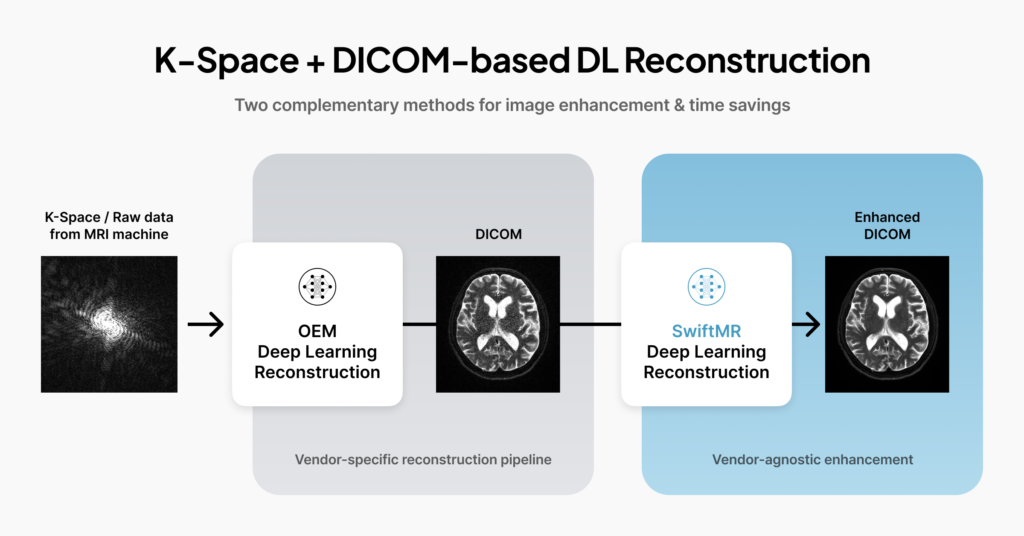
SwiftMR works differently from OEM DL reconstruction. While OEM DL operates within the vendor-specific reconstruction pipeline before the DICOM image is produced, SwiftMR works after reconstruction, at the DICOM level. It takes the reconstructed image as its input and applies an additional AI-powered enhancement process to create the final enhanced image.
This means SwiftMR is not replacing OEM DL. It is extending what OEM DL can help achieve.
Here are seven ways SwiftMR improves OEM DL reconstruction for radiology practices.
1. SwiftMR Extends Image Quality Beyond the OEM Reconstruction Step
OEM DL reconstruction is powerful because it is built into the scanner vendor’s reconstruction environment. It is designed around that vendor’s hardware, software, acquisition strategy, and reconstruction pipeline.
SwiftMR adds another layer of value after that reconstruction step.
Because SwiftMR operates at the DICOM level, it can evaluate the reconstructed image and apply additional enhancement across image-quality dimensions such as noise behavior, edge definition, anatomic clarity, and acceleration-related degradation.
For radiologists, this matters because the final image is what supports interpretation. SwiftMR is designed to improve that final image while preserving the diagnostic information needed for confident reading.
2. SwiftMR Helps Reduce Noise While Maintaining Clinically Relevant Detail
Noise reduction is one of the most important benefits of DL-enhanced MRI, but radiologists also need confidence that subtle findings are preserved.
SwiftMR’s DICOM-based enhancement framework is designed to reduce noise while maintaining clinically relevant image detail. This is especially important in accelerated acquisitions, where shortening scan time can increase the risk of reduced SNR or less stable image appearance.
The goal is not simply to make the image look smoother.
The goal is to improve readability while maintaining the anatomic and pathologic detail radiologists rely on.
3. SwiftMR Enhances Edge Definition and Anatomic Clarity
Radiologists depend on more than low-noise images. They need clear anatomy, reliable tissue boundaries, and sufficient edge definition to interpret studies with confidence.
SwiftMR evaluates the reconstructed image and applies enhancement designed to improve edge detail and anatomic clarity. When used with OEM DL, this can help produce images that are not only faster to acquire, but also easier to interpret.
That distinction matters.
A faster scan is only clinically valuable if the resulting image remains reliable, interpretable, and diagnostically meaningful.
4. SwiftMR Supports Additional Acceleration Potential
OEM DL can help MRI teams accelerate supported protocols within the vendor reconstruction pipeline. SwiftMR adds another opportunity to improve scan-time efficiency after the reconstructed image is produced.
By pairing OEM DL with SwiftMR’s DICOM-based enhancement framework, radiology practices may be able to pursue higher acceleration potential while maintaining focus on image quality and diagnostic confidence.
For operations teams, this is where the value becomes measurable.
Shorter scan times can help reduce schedule pressure, increase scanner availability, and create more usable capacity from existing MRI systems.
5. SwiftMR Helps Standardize Image Quality Across Mixed MRI Fleets
Many radiology practices do not operate a uniform scanner environment.
They may have different scanner models, different vendors, different software levels, and both 1.5T and 3T systems. This can make protocol standardization difficult, especially when image quality varies across sites or systems.
Because SwiftMR operates at the DICOM level, it is not tied to a single vendor reconstruction method or k-space sampling strategy. This allows it to provide a more consistent enhancement layer across a broader range of scanners and protocols.
For radiology leaders, that consistency can be especially valuable across multi-site practices and enterprise imaging networks.
6. SwiftMR Extends Benefits Across More Clinical and Technical Scenarios
OEM DL reconstruction is typically optimized for defined scanner, software, sequence, and protocol conditions. That is not a flaw. It is the nature of vendor-integrated reconstruction.
SwiftMR was built as an all-in-one, vendor-neutral, DICOM-based enhancement framework designed to operate across a broad range of clinical and technical scenarios.
That broader applicability helps radiology practices extend DL-enhanced MRI benefits beyond a single OEM reconstruction pathway. This can be especially useful when practices want to improve image quality and scan-time efficiency across diverse anatomies, sequences, protocols, field strengths, and scanner configurations.
7. SwiftMR Helps Convert Scan-Time Reduction Into Operational Value
For radiologists, the first priority is diagnostic confidence.
For operations teams and CEOs, the next question is what improved scan efficiency makes possible.
When MRI scan time is reduced without compromising image quality, practices can create additional operational value from scanners they already own. That can mean more appointment slots, better scanner utilization, less schedule congestion, shorter patient wait times, and reduced pressure to immediately invest in new MRI hardware.
In this sense, SwiftMR does not only improve the image.
It helps radiology practices unlock more value from their existing MRI infrastructure.
A More Complete Approach to DL-Enhanced MRI
OEM DL reconstruction has already helped move MRI beyond the long-standing trade-off between speed, SNR, and resolution. SwiftMR extends that progress by adding a DICOM-based enhancement layer after OEM reconstruction has been completed.
Together, OEM DL and SwiftMR can help radiology practices achieve:
- improved image quality
- reduced noise
- enhanced edge detail
- higher acceleration potential
- greater protocol consistency
- broader applicability across scanners and protocols
- more efficient MRI workflows
- continued diagnostic confidence
The result is a more complete approach to DL-enhanced MRI — one that combines the strengths of vendor-specific reconstruction with the flexibility of SwiftMR’s DICOM-based AI enhancement framework.
For radiologists, that means images that remain reliable and clinically meaningful.
For operations teams, it means faster MRI workflows and better use of existing scanner capacity.
For CEOs and imaging leaders, it means a way to improve performance without immediately adding new hardware, rooms, or staffing.
To learn more about how SwiftMR works in conjunction with OEM deep learning reconstruction technologies, contact Anthony Rodenberg, BA RT(R)(MR), Director Clinical Programs at AIRS Medical.