A smoother MRI image is not necessarily a higher-resolution MRI image.
That distinction is important because spatial resolution in MRI has traditionally been tied to the acquired matrix and field of view. Finer spatial detail requires more phase-encoding steps, which increases scan time.
Deep Learning Super Resolution approaches the problem differently.
With SwiftMR Tunable Resolution, higher-resolution images can be reconstructed without requiring a higher acquired matrix — giving imaging teams greater flexibility in how they balance acquisition speed and spatial detail.
The traditional acquisition matrix–resolution trade-off
Increasing the acquisition matrix allows MRI to capture finer spatial detail, but it comes with familiar trade-offs.
A higher matrix generally means:
- Longer acquisition times
- Lower SNR
- Greater opportunity for patient motion
- More constraints when optimizing protocols for speed
As a result, protocol design often involves balancing spatial resolution against acquisition time and image quality.
SwiftMR changes that relationship by applying Deep Learning Super Resolution during reconstruction.
The output matrix can be selected independently of the acquired matrix, with reconstruction up to 1024 × 1024.
What does MRI interpolation actually do?
Interpolation lays a finer display grid over the same acquired data. The image may appear smoother because the transitions between pixels are less obvious. But the true voxel size does not change.
That means interpolation does not increase the ability to distinguish between adjacent structures. It changes how the existing information is represented rather than increasing the underlying spatial resolution.
In simple terms:
Interpolation can make an image look smoother. It does not make the acquired detail more resolvable.
How is DL Super Resolution different?
SwiftMR Deep Learning Super Resolution reconstructs voxels smaller than those acquired, rather than simply modifying voxel spacing.
Super Resolution is applied across all encoding directions, allowing SwiftMR to reconstruct smaller voxels than were acquired.
The practical distinction is important:
- Interpolation changes the representation of the existing information.
- Super Resolution reconstructs finer spatial detail.
For the radiologist, the relevant question is not simply whether an image looks sharper.
It is whether the reconstruction improves the ability to distinguish between adjacent structures.
One acquisition. Seven resolution choices.
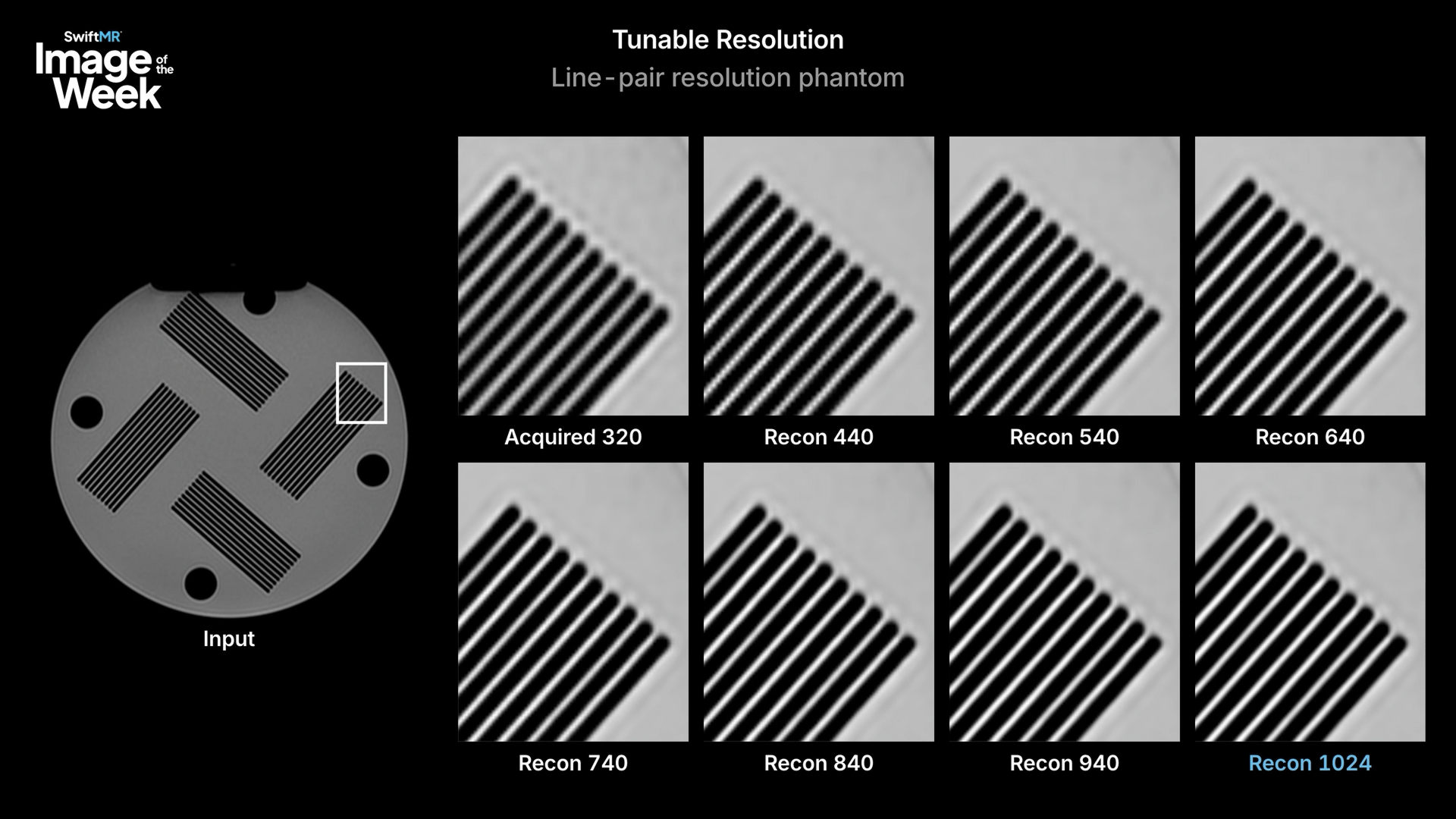
SwiftMR Tunable Resolution allows users to select from seven Super Resolution levels from a single acquisition.
In the line-pair phantom below, the same acquisition is reconstructed from the conventional image through a range of customizable reconstruction matrices.
As the Super Resolution level increases, the phantom demonstrates progressive changes in the visibility and separation of fine spatial detail.
How high should you reconstruct?
Higher isn’t automatically better. The useful range depends on the acquired matrix, the anatomy, and how much of the image is noise rather than signal. Reconstructing a 192 × 192 acquisition at 1024 × 1024 is a different proposition from reconstructing a 384 × 384 at 512 × 512.
The line-pair phantom provides a controlled demonstration of how reconstructed spatial detail changes as the Tunable Resolution level increases.
What can Super Resolution change in the reconstructed image?
The impact goes beyond simply creating a sharper-looking image.
Potential image and workflow benefits include:
Reduced Gibbs ringing
Super Resolution can reduce the appearance of Gibbs, or truncation, ringing around high-contrast boundaries.
Reduced staircase-like edge pixelation
Low-matrix reconstructions can produce visibly stepped edges. Higher-resolution reconstruction can reduce this staircase-like appearance and improve edge definition.
Higher resolution from lower-matrix acquisitions
Because reconstructed resolution is not limited to the acquired matrix, protocols can use lower-matrix acquisitions while reconstructing the resulting images at a higher resolution.
Lower acquired matrix, shorter scan times
Reducing acquisition time means the patient spends less time remaining still during individual sequences, reducing the opportunity for motion-related degradation.
Greater flexibility in protocol optimization
Tunable Resolution gives MRI teams another parameter to adjust based on the anatomy, sequence, and clinical requirements of an examination.
What does this mean for clinical MRI?
The phantom demonstrates the technical principle, but the clinical question is ultimately more important:
Does increased reconstructed resolution improve the delineation of fine anatomical structures?
That is where Super Resolution becomes more than an image-processing feature.
By allowing spatial resolution to be adjusted independently of the acquisition matrix, SwiftMR gives radiologists and MRI teams greater flexibility to optimize protocols around both acquisition speed and spatial detail.
Instead of relying on a higher acquired matrix as the only path to finer resolution, sites can use shorter acquisitions and reconstruct the resulting images at a higher resolution.
Rethinking the resolution trade-off
MRI has traditionally required a compromise between spatial resolution, scan time and SNR.
Deep Learning Super Resolution changes how that trade-off can be approached.
With SwiftMR Tunable Resolution, imaging teams can reconstruct smaller voxels than were acquired and select the resolution level best suited to the examination.
Faster acquisition. Higher reconstructed resolution. More flexibility in how MRI protocols are optimized.
Learn More
Want to see the difference SwiftMR Tunable Resolution could make on your MRI system? Explore more clinical images in the AIRS Medical clinical image gallery.
For additional clinical examples or protocol discussions, contact Keaur Patel, BA, R.T.(R)(MR)(ARRT), Director of Customer Success.