Open MRI systems fill an important role in imaging patients who may struggle with a conventional closed-bore scanner. Their open architecture can make MRI more accessible for claustrophobic, bariatric, pediatric, elderly, and acute-pain patients, while also giving imaging centers another option for patients who may otherwise have difficulty completing an exam.
The tradeoff is that low-field MRI like the APERTO 0.4T typically operates with less available signal than higher-field systems. Maintaining diagnostic image quality may therefore require longer acquisition times, thicker slices, or compromises in spatial resolution. That makes the relationship between acquisition time, spatial resolution, signal, and patient motion particularly important.
This Sagittal T2 lumbar spine case demonstrates how SwiftMR® can be used to change that balance.
Sagittal T2 lumbar spine: 3:32 to 2:14
This Sagittal T2 lumbar spine was acquired on an APERTO 0.4T using the following parameters:
| Acquisition | Resolution | Scan time |
|---|---|---|
| Standard of care | 0.6 × 0.6 × 5.0 mm | 3:32 |
| SwiftMR | 0.4 × 0.4 × 4.0 mm | 2:14 |
With SwiftMR, the voxel volume was roughly three times smaller, even with a scan duration that was 78 seconds faster.
Compared with conventional acquisitions that often force a choice between resolution and speed, this acquisition provides:
- Recovered SNR on a low-signal acquisition
- Thinner slices with less partial volume averaging
- Clearer disc, endplate, and canal detail
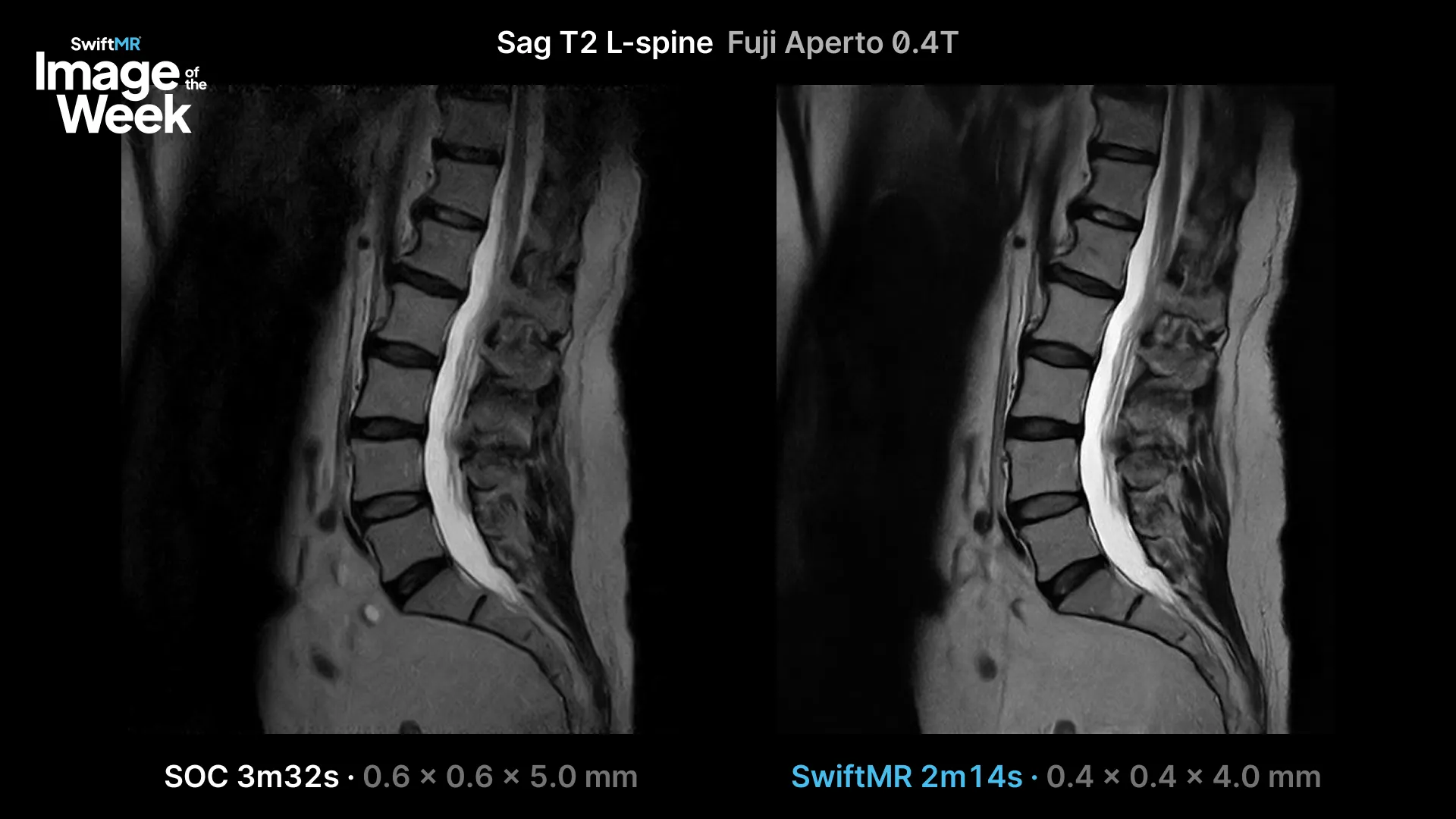
In this acquisition, in-plane resolution improved from 0.6 × 0.6 mm to 0.4 × 0.4 mm, while slice thickness decreased from 5 mm to 4 mm.
That combination can help improve visualization of anatomy relevant to findings such as:
- Endplate changes
- Far-lateral disc herniations
- Foraminal narrowing
- Lateral recess narrowing
- Disc and canal morphology
Importantly, these improvements were achieved while the acquisition itself became shorter rather than longer.
Shorter acquisitions may matter even more on open MRI
On a single sequence, saving 78 seconds on one acquisition makes a notable operational difference. Compounded across a standard five- or six-sequence lumbar series, those savings open up additional slot capacity.
Reduced scan times directly benefit the core patient demographic using open MRI, including pediatric, bariatric, claustrophobic, and acute-pain patients. Less time on the table minimizes patient movement, leading to fewer repeat scans and better overall image quality.
Extending the performance of existing MRI infrastructure
The APERTO case also illustrates a broader point about MRI optimization.
Improving MRI performance does not necessarily mean replacing an existing scanner or moving every patient to a higher-field system.
For imaging organizations operating established low-field or open MRI systems, reconstruction technology can provide another way to improve the performance of the infrastructure already in place.
Learn More
Want to see what SwiftMR could do on your MRI system? Explore more clinical images in the AIRS Medical clinical image gallery.
For additional clinical examples or protocol discussions, contact Keaur Patel, BA, R.T.(R)(MR)(ARRT), Director of Customer Success.