Extend the Value of Your Siemens Espree
Replacing an MRI costs capital, construction, and months of downtime. That arithmetic is why the Siemens MAGNETOM Espree 1.5T, out of production for years, still runs in fleets worldwide.
It earns the space. The 70 cm bore and 125 cm system length, the shortest 1.5T magnet Siemens built, let roughly 60% of exams run head-out. Patients who are claustrophobic, larger, elderly, or mobility-limited get scanned on an Espree when they cannot be scanned anywhere else in the building. It carries routine brain, spine, musculoskeletal, and body work.
The Espree, however, presents trade-offs. Its 1.5T platform delivers less signal than 3T. Maximum field of view is 45 × 45 × 30 cm, with homogeneity specified over 30 cm, so long-axis anatomy needs multiple stations and stitching. Short-bore geometry raises sensitivity to centering, off-isocenter imaging, and fat suppression.
Because Espree systems were installed more than a decade ago, their legacy syngo MR software environment is another consideration. The scanner’s software version and configuration can affect workflow, integration, and compatibility with newer imaging technologies.
However, for hospitals and imaging centers, keeping an Espree in service avoids the capital cost, construction, downtime, and disruption associated with scanner replacement.
The Siemens Espree Challenges for MRI Technologists
A patient-friendly bore does not mean a shorter exam.
The Espree’s shorter magnet can limit longitudinal coverage. Long-axis examinations may require multiple acquisitions and image stitching, adding technologist steps and examination time. As a 1.5T system, it also has less inherent signal-to-noise ratio than a 3T scanner. Imaging teams must balance scan time, resolution, anatomical coverage, slice thickness, and image noise.
Some examinations may also be more sensitive to positioning, shimming, coil placement, and off-isocenter imaging. This can contribute to uneven fat suppression, signal variation, distortion, or repeated sequences.
The Business, Operational, and Clinical Impact of the Siemens Espree
Imaging executives are deciding whether the Siemens Espree can keep meeting expectations for capacity, image quality, patient experience, and fleet consistency, or whether it is time to spend the capital.
For MRI managers and operations leaders, the priority is protecting throughput while prioritizing patient care.
For radiologists, faster examinations only create value when the resulting images remain clinically useful and support confident interpretation. On an established 1.5T platform, that means reducing scan time without introducing unacceptable noise, loss of detail, inconsistent fat suppression, or motion-related degradation.
The following case studies show how imaging centers used SwiftMR to shorten examinations, improve image quality, and extend the value of their existing Espree scanners—without replacing the scanner or its underlying software platform.
Case Study: Midwestern US Hospital
SwiftMR Delivered a 45% Average Scan-Time Reduction Across 15 Espree Protocols
A midwestern US hospital implemented SwiftMR on a Siemens MAGNETOM Espree 1.5T across neuro, spine, and musculoskeletal imaging. Average scan time was reduced by 45%, with every one of the 15 evaluated protocols improved, with reductions from 34% to 61%.
Scan time reduction was impressive:
- Shoulder: 19:54 to 7:50 — 61%
- Knee: 21:18 to 9:28 — 56%
- Routine brain: 20:48 to 9:51 — 53%
- Ankle: 22:45 to 10:40 — 53%
- Foot: 22:09 to 11:59 — 46%
Results were also consistent across cervical, thoracic, and lumbar spine protocols, with reductions ranging from 37% to 43%, including examinations performed with and without contrast.
| Body part | Scan time (Before) | Scan time (After) | Reduction |
|---|---|---|---|
| Brain (routine) | 20:48 | 09:51 | 53% |
| Brain (stroke) | 26:37 | 17:32 | 34% |
| Brain (tumor) | 31:05 | 17:57 | 42% |
| Brain (IAC) | 36:11 | 22:07 | 39% |
| C-Spine W/O | 23:41 | 13:30 | 43% |
| C-Spine W/WO | 28:29 | 17:32 | 38% |
| T-Spine W/O | 21:14 | 12:22 | 42% |
| T-Spine W/WO | 30:19 | 19:10 | 37% |
| L-Spine W/O | 20:51 | 12:46 | 39% |
| L-Spine W/WO | 30:58 | 17:30 | 43% |
| Knee | 21:18 | 09:28 | 56% |
| Ankle | 22:45 | 10:40 | 53% |
| Shoulder | 19:54 | 07:50 | 61% |
| Foot | 22:09 | 11:59 | 46% |
Impressive Acceleration Across the Clinical Workload
The breadth of these results is significant. SwiftMR did not accelerate a single favorable sequence. It cut time across routine and specialized brain imaging, all three spine regions with and without contrast, and four musculoskeletal exams. Spine protocols clustered tightly, between 37% and 43%, which is what a scheduler needs: predictability.
Case Study: Centroeco, Brazil
SwiftMR Accelerated Siemens Espree Spine and MSK Imaging up to 56%
Centroeco, a diagnostic imaging center in Novo Hamburgo, Brazil, rather than invest in new scanners, implemented SwiftMR on their Siemens Espree 1.5Ts.
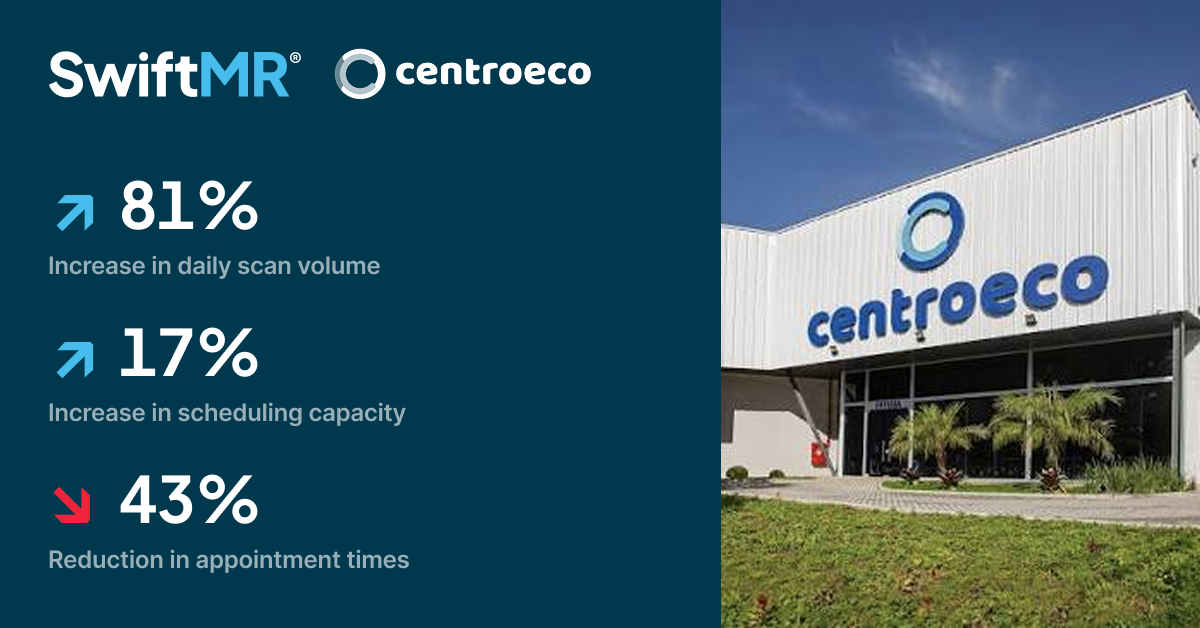
The impact was significant: an 81% increase in daily scan volume, a 43% reduction in appointment times, and a 17% increase in scheduling capacity.
The benefits extended beyond workflow efficiency. SwiftMR achieved faster acquisitions while producing sharper images and reducing motion artifacts, improving diagnostic confidence. The chart below shows the scan-time reductions achieved across Espree spine and musculoskeletal protocols.
| Protocol | Original scan time | With SwiftMR | Scan time reduction |
|---|---|---|---|
| Foot | 11:38 | 5:07 | 56% |
| L-spine | 11:14 | 5:01 | 55% |
| Hip | 13:15 | 6:19 | 52% |
| C-spine | 9:45 | 5:25 | 44% |
| T-spine | 11:32 | 6:36 | 43% |
Faster Acquisitions with Improved Image Quality
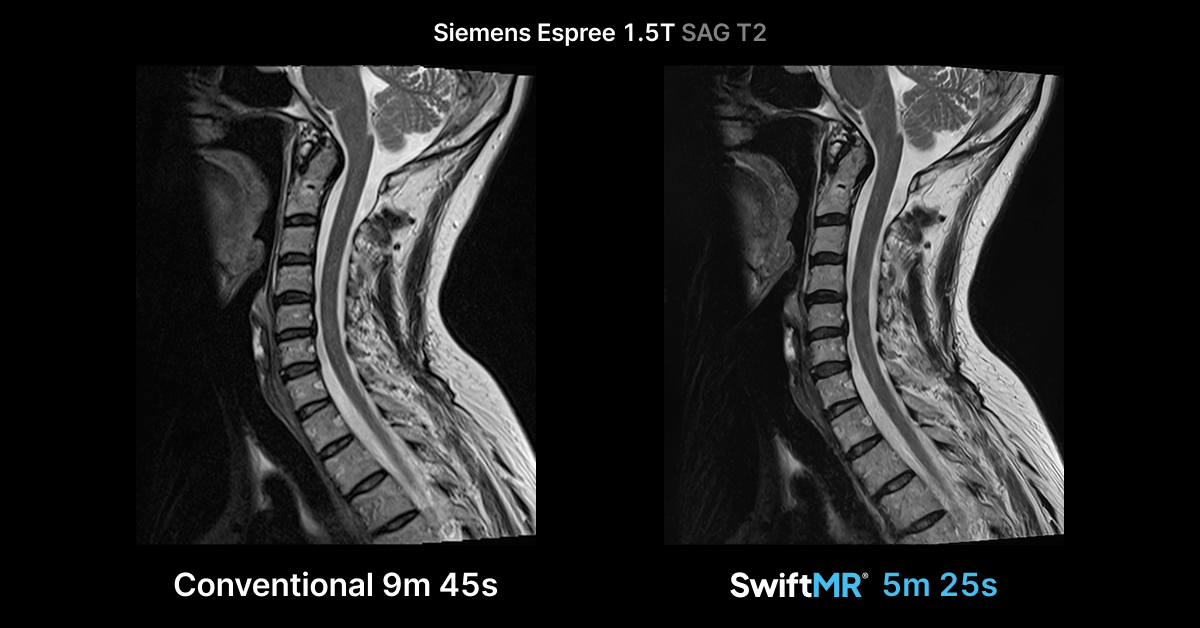
The results extended beyond scan-time reduction. Centroeco reported improved image quality and that faster acquisitions helped reduce motion artifacts. In the Espree C-spine sagittal T2 example, scan time was reduced by more than four minutes—from 9:45 to 5:25—while maintaining the anatomical detail needed for interpretation.
Read the case study: Customer Story: Centroeco.
SwiftMR Optimizes the Clinical and Operational Value of a Siemens Espree 1.5T
For imaging executives, SwiftMR offers a way to increase the return on an existing asset before committing to scanner replacement. For operations teams, shorter acquisitions turn into scheduling flexibility: Centroeco went from 8% of the day open to 25%.
For radiologists, the test is whether accelerated exams still support a confident read, which is why both sites ran clinical evaluation before going live.
Together, the results show that using AI-reconstruction technology with a legacy Siemens Espree can deliver meaningful value across patient access, clinical performance, and operational efficiency—without requiring a hardware upgrade.
Get More from Your Siemens Espree
See what SwiftMR does to your scan times, on your Espree, with your protocols. AIRS Medical offers a 30-day trial with matched DICOM series, not compressed screenshots.
Frequently Asked Questions
Does SwiftMR require replacing or upgrading the Espree syngo software?
No. SwiftMR works downstream of acquisition, taking DICOM output from the scanner, processing it, and returning the series to PACS, typically in under two minutes. There is no syngo version upgrade and no change to the scanner’s reconstruction pipeline. Installation runs two days: a gateway PC and protocol setting on day one, user training and monitoring on day two. Protocol setting is done on the MR console itself, so scanner availability needs scheduling. Exact routing, series naming, and display configuration are confirmed during technical implementation and tested against your PACS and syngo environment.
Can SwiftMR automate MIP generation?
SwiftMR supports derivative images including MIP and ADC. The source series is processed and the result is sent to PACS. Processed images can also be sent back to the MR scanner so it generates derivatives from the enhanced source. Confirm the specific derivative workflow for your protocols during implementation.
Does SwiftMR correct every limitation of the Siemens Espree?
No. SwiftMR does not change the scanner’s 1.5T field strength, z-axis coverage, or field uniformity. Positioning, shimming, coil selection, and protocol optimization remain as important as they were before.
Does SwiftMR make a Siemens Espree equivalent to a 3T scanner?
No. SwiftMR improves scan efficiency and image quality on the Espree you already have. It does not change the inherent signal characteristics of a 1.5T system.
Can SwiftMR support an Espree within a mixed MRI fleet?
SwiftMR is designed as a vendor-neutral solution for organizations operating scanners from different manufacturers, models, field strengths, and software generations.
Does SwiftMR preserve anatomical detail and lesion conspicuity?
Published peer-reviewed studies have demonstrated at least non-inferiority to standard imaging. A prospective multi-reader, multi-vendor study reported a 41% average scan-time reduction without degrading image quality or diagnostic performance across readers or platforms.
Does SwiftMR alter image contrast or create artificial anatomy?
Contrast, TR, and TE are not manipulated during protocol optimization. Accelerated sequences are reviewed for artifacts, image uniformity, geometric accuracy, resolution, and slice-thickness requirements before clinical use.
Can SwiftMR correct uneven fat suppression or field-inhomogeneity artifacts?
No. Magnetic field, bore geometry, and shimming performance are unchanged. Proper positioning, coil selection, shimming, and protocol optimization are still necessary, and radiologists should review fat-suppressed and off-isocenter sequences carefully during clinical evaluation.
Can image appearance be adjusted to our radiologists’ preferences?
Yes. Clinical evaluation runs as a collaboration between your radiologists, your technologists, and AIRS clinical applications specialists. Parameters are refined against radiologist feedback before sequence optimization is finalized.
Will the images arrive in PACS as part of the normal reading workflow?
Yes. SwiftMR processes and returns DICOM for review inside the existing workflow. Routing, series naming, and display configuration are confirmed during implementation and tested with your PACS and syngo environment.
Can we review matched DICOMs rather than compressed screenshots?
Yes. AIRS Medical offers a 30-day free trial, allowing your team to evaluate SwiftMR on your own Espree, protocols, and clinical workflow.